
Skip navigation
BLOG  |  JULY, 2009

A Value-Based Content Strategy

July 14, 2009 at 2:00 pm
by Chris


Are you overwhelmed by the web? I am. You probably are, too, but are a little afraid to admit it. Perhaps the better question would be, "How overwhelmed are you by the web?" The rate at which the web grows in content is astounding, and for those who try to keep up with a lot of content whether personally or professionally, it can feel frustrating, exhausting, even futile. That's because it's all of those things. Really, something's got to give. So, I want to get real with our content: with the newsletters, the blog, my use of social media on behalf of Newfangled, all of it (hence the emotiface above).

Just to be clear, I'm not advocating giving this whole web thing up. Not even close. Newfangled is thriving today in a way unlike ever before, and I'm not about to bite the hand that feeds me. However, we are reaching a point at which our content strategy needs to change. For a while now, we've been operating at a crazy rate, adding sometimes more than several blog posts a day during the work week and a new newsletter and webinar every month, all of that on top of the actual work (web development and consulting) that we're contracted to do. Busy isn't the word; it's something more than that. But now, I believe we need to think more in terms of value, not amount. This is easy to say- surely you've heard it before- but it's much more difficult to actually believe in enough to do. I think most people would agree that quality is more important than quantity, but most people clearly don't agree with this in practice. I've been guilty of this too and I want to change. Let me explain:

I tend to keep several things open throughout my day that help me to monitor what's going on within my network: Facebook, Twitter, Tumblr, and Google Reader. These applications contain a bit of overlap (i.e. some of the same names/content in Twitter and Tumblr), but not a ton, so to say that I am inundated with content throughout the day would be an understatement. As a result, I feel a consistent anxiety, partly due to the pace of it all, but also because I can get swept up in the fear of not being able to keep up, not having my face pop up in other people's Twitter/Facebook/Tumblr feed as often as those whom I'm connected to pop up in mine. It is discouraging when I face that my fear indicates a practical belief in quantity over quality. But when I stop to consider which people stand out from the crowd of my network, it's always those people that post less, but more valuable content. Because "valuable" can be pretty subjective, let me elaborate on what I mean by "valuable." Ultimately, it means an emphasis on longer, more specific thoughts, but when posting quick links or reposting, including an explanation as to why that content is valuable to them and even including their own thoughts on it. As an example, I've included a screenshot (below) of a post from a woman I follow on Tumblr named Nina, a smart, 20-year-old product design student at Stanford.
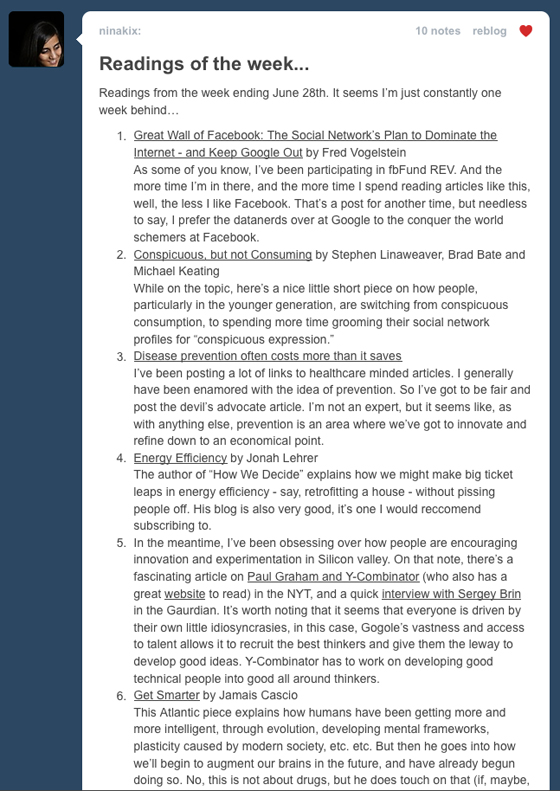


I don't know Nina personally, nor can I even remember how I ended up finding her Tumblr page, but if all she ever posted was this kind of thing once a week, I'd still follow her and she'd still stand out. This "readings of the week" post does three particular things that make it valuable to me: (1) Nina's descriptions actually inform me and help me to decide if I want to read the content she's linking to, (2) it's clear that she has actually read the content she's linking to and cares enough about it to share it purposefully, and (3) this curated list tells me much more about Nina than if she'd simply pasted the links alone.

I believe that Newfangled consistently puts out high-quality content, but I want to make sure I'm using this quality model for everything I do- especially the stuff that is easy to just "keep up with"- the Tumblr, Twitter, Facebook kind of stuff. I think if we all did this, we'd stand to get much, much more from the web without the same potential of being frustrated, exhausted or jaded. What do you think?


Comments
Nolan Caudill | July 13, 2009 2:44 PM

As a fairly active user of Tumblr and Delicious, I've come to appreciate this approach and have thought about adopting it as well. Seeing a few, very high quality links at one time solidifies in the reader's mind the authority of the sharer. That's hard to convey when you see a constant stream of one-off links, especially if there is not a consistent level of quality between all of the links.

Another site I found that does this is the O'Reilly Radar (http://feeds.feedburner.com/oreilly/radar/atom). They have regular blog posts of new content, but once a day they do something called "Four Short Links." These are always high-quality and interesting links and a thought or two about each one. This makes the blog stand out a little more and sets it above the normal one-at-a-time rebloggers.
Chris Butler | July 13, 2009 3:34 PM

Nolan,

The only thing that makes it tough for me is that I come across so many things in a day and tend to want to share many of them. But I realized that I was probably over-sharing on Facebook when my younger brother made up a rap about me called "Chris Butler Has Shared a Link" and performed it for me last Christmas. That was a wake-up call for me to chill with the sharing overkill and be more intentional about what I share. I'm still getting the hang of it now and am sure I'm still within overkill territory.

Chris
Richard | July 13, 2009 4:22 PM

Props for preachin' it. I've noticed this overkill happening a lot on tumblr's network particularly. What is your tumblr page url?
Alex | July 14, 2009 9:42 AM

I agree with this, too. I saw something recently on Twitter about what value you're adding if all you do is repost links or whatever the latest news is. Just keeping yourself visible isn't enough. It's all about value.
Amy | July 14, 2009 11:43 PM

Yes, I'm totally overwhelmed by the web, even though it's my job to be current online and know what's hot with social media, etc. It's really annoying that it just never stops and all I can do is barely keep up. It seems like coworkers and competitors are just online 24-7, doing nothing but twittering or posting to Facebook or blogging or whatever. And here I am posting this comment at almost midnight. Great. Anyway, I wish more poeple would come to the realization you have and speak up and put their foot down. We don't need to live like this.
Chris Butler | July 15, 2009 1:15 PM

@Richard, Thanks for the props! I've noticed it on Tumblr, too, but I've been intentional about changing my own "ways" there and pruning my follow list. My Tumblr page is at http://www.chrbutler.com.

@Alex, I completely agree. The purpose of any of this should be sincerely adding value.

@Amy, I feel your pain. Thanks for the comment!
Ira | July 16, 2009 11:25 AM

But if all you're doing is providing links (presumably to someone else's content) with maybe a little commentary, are you really adding volume? I mean, what's the point of commentary if EVERYONE is commenting?
Chris Butler | July 17, 2009 1:45 PM

@Ira, It's a good point. I think there is room for some people on the internet who primarily want to recommend and direct others to good content (human aggregators or curators) as well as those who want to create new content. We need both types and plenty of examples of behavior in between.
Pak-Kei | August 21, 2009 5:54 PM

I beg to differ. Long posts such as the ones you described completely breaks the flow of my reading on Tumblr and Twitter. The intention of Twitter/Tumblr is to turn information into bite-size digests.

Unlike what you said, I don't think she actually posts 'less' in terms of "quantity", because she simply just post a lot of things in one post. What she did 'less' is not posting all the time, and when she does, she posts in a somewhat rigorous interval (which means if I don't have the same living schedule as her, I will never catch her post, vice versa) with a good commentary on each item. What she contributes is "regularity" and "quality".

It seems to me that a long post is 'authoritative' only because it all in a sudden commands all attention and takes up all my screen space, in the middle of my scrolling down the infinite page. To me, it is almost rude and against the etiquette of such feed engines. Splitting a long list into individual posts will help me digest them, both from a UI legibility standpoint and a post management standpoint.

Meanwhile, I do like the author's commentary of each link. IMO, it solves the problem with Tumblr, i.e. the concept of 'reblogging'. While it is nice to share what others had posted, most people added little to the post. The good posts tend to be the ones with a good and interesting viewpoint of the subject matter... and the ones that I can catch.

It's pretty Buddhist in a way, that if you don't ever meet a person, it's just fate. It's probably time for us to realize that our rate of reading will never catch up with the speed the Internet expands - and it doesn't matter.

* * * * *

The timing of this article is eventful because just a couple days ago the Reader's Digest filed bankruptcy. The magazine is probably one of the earliest human content aggregators, before we all start doing it ourselves on Twitter or Tumblr. Often they simply cut and paste articles from other magazines to form an issue, with occasional writers bridging the articles together. It seems that, in the age of Internet, such aggregating magazines are pretty much useless, as anyone can easily become a human aggregator by linking articles around the web.
Chris Butler | August 22, 2009 11:11 AM

Pak-Kei,

Do you still go by Leo? Thanks for reading and the comment. I didn't mean to suggest that length of post was the most critical attribute. Rather, as you point out, "less" meant less in terms of frequency, but the balance was the richness of her posts. Long posts can be appropriate if the content is worth being long, and I think are just fine in the context of engines like Tumblr.

Chris