
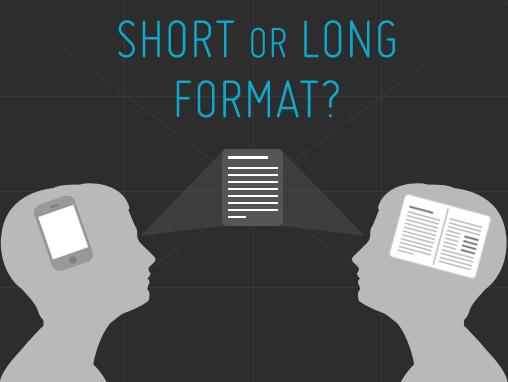
Last week I noted a post by John Hagel called Stupidity and the Internet in my post on the The Post-Screen Web. Hagel covered several topics in that post, one of which was the web’s effect upon thinking and whether short-form content makes that effect a negative one. He writes:
If it is about content, will snippets trump books and will we all be dumber for it? As someone who has never mastered the art of the snippet, let me proudly count myself as one who still sees profound value in the long form where texture and nuance can be teased out and explored… Snippets of information, loosely coupled, have enormous value in enhancing peripheral awareness and provoking new ideas. At the same time, snippets of information alone are deeply dangerous. They distract us with never-ending waves of surface events, spreading us ever thinner and obscuring the deeper structures and dynamics that ultimately are shaping these surface events. Those of us who stay only on the surface, swimming in a sea of snippets, will ultimately lose sight of land. We need books, or whatever the digital long forms of content are that will replace the book, to help us penetrate the surface and explore the deeper structures and dynamics that make sense of the changes around us.
Don’t Panic! We’re in the thick of it, but all is not lost.
Ultimately, I think that Hagel is right. In fact, I agree with many of the thinkers who are concerned with the future of literacy in light of our digital life. I am concerned too. When writer’s like Nicholas Carr talk about not being able to focus on a book like they used to, I can relate. But I’m not ready to declare a state of emergency. I think we’re in the middle of a significant shift in the way we engage with information and learn because of technology and that there’s no compelling reason to assume that reading will die. For more optimism like this, watch Andrea Lunsford, a researcher at Standford University, describe her study which led her to conclude that student writing ability has not declined as a result of recent technological changes.
There is a place for both short and long-form writing.
In the meantime, there is a place for both short and long-form writing. Each form has merit as a content strategy, depending upon the goals the writer has. In a presentation I gave recently called Professional Writing for the Unprofessional Writer, I elaborated on the different functions of short formats (i.e. blogs), and longer formats (i.e. monthly newsletter articles or whitepapers). Here’s the gist of it:
Short-Form (Blogs)
Blogs take a cumulative approach to tell an ongoing story with many short posts. In other words, if you blog on behalf of your company, you’ll want to think long term, allowing the “idea” or identity of the company to be worked out over potentially years of regular posting. Remember, blogs are essentially relational, so when someone subscribes to your blog’s RSS feed, they’re making a commitment to getting to know you and/or your company. The way you write should respond to that fact. One other thing that I really value about blogging is that it provides a good opportunity to explore new and untested ideas. I feel free to ruminate on things that might be risky and even say things that I’ll disagree with later when writing for our blog in a way that I don’t with our newsletter.
Long-Form (Newsletter Articles)
Long format writing, on the other hand, develops a single idea in a more in-depth manner contained in one article. This kind of writing requires a more strategic approach. Because of the infrequency of this format (for example, I write one newsletter article each month) your ideas need to be as tested as possible. You’re going “on the record” in each article, and at the rate of 12 a year, it will take much longer to bury an idea that you’ve come to disagree with than it might had you written about it in your blog.
Patience
The only additional consideration of the long-form is that it is much more difficult to win readers than it is with short-formats. It obviously requires much more investment- attention and time- of the reader to get through multiple pages of content, so you have to captivate them early. This is not easy. I’m not sure I know how to do this consistently.
No matter what format you choose to write with, you must be patient and let your voice develop over time. Writing is an art that takes years of repetitive practice to do even passingly well. Again, I’m not sure where I am with that, but I know by reading things I wrote even last year that any improvement from then I owe to the commitment to regular writing.
Related Posts
-

Christopher Butler will be a keynote speaker at the 2015 ConvergeSE conference...
-


Chris Butler will be speaking at the concluding session of the AIGA's Web101 course...
-
Chris Butler is MC'ing at this year's Hopscotch Design Festival...