
What is valuable is entirely subjective, so for the purposes of this article, I’d like to define what I mean by valuable content in this way: Valuable content is material created for your prospects that engages their need and brings them into relationship with you. This definition may require you to completely rethink your content strategy. Or it may simply merit a subtle tweak in factors like the type of content you’re creating, messaging, or frequency. Either way, if you do calibrate your strategy for value, your content will be more in tune with the needs of the people you are positioned to speak to by your expertise, and therefore much more likely to convert them from passive readers to real prospects. But before we get into our conclusions about how to create valuable content, I’d like to demonstrate how the evaluation of our own website data brought us to them.
When asked how they initially found out about us, many of our clients will recall searching for something online and finding our site among a search engine’s results. Great, SEO win! But that’s not really the full story. They usually go on to say that landing on our site began a long relationship with our content, sometimes lasting years, that preceded becoming a client. These people’s extended use of our site speaks to the high value of our content to them. But what this ultimately shows is that, no matter how long their “vetting” process, a site’s visitors offer very little value to you until you have converted them to prospects. So, think about this in terms of your site: How much site traffic is actually converted and where does it come from?
More conversions come from human referrals than from search engine traffic.
Take a moment to let that sink in. More conversions come from human referrals than from search engine traffic. Knowing that our site received the vast majority of its traffic from search engine referrals, and that we performed quite well for phrases directly related to what we do, like “defining a web content strategy,” “how to do SEO,” or “website development pricing,” I would have assumed that most of the people subscribing to our newsletter, registering for our webinars, or requesting meetings with us are referred by search engines. But after reviewing the data, I have concluded that this is not the case at all.
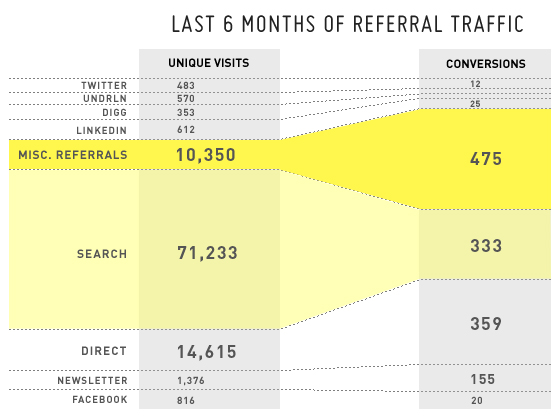
The image above depicts the 9 top referrers of traffic to our website, showing how many unique visits and eventual conversions came from each over the past 6 months. As expected, the top referrer to our site, exceeding direct visits by almost 5 times, was search engine traffic (Google, Yahoo, and Bing). However, out of the 71,233 visitors who came to our site from a search engine, only 333 of them ended up converting to an actual lead. That’s a paltry fraction of a percent (.47%). Our miscellaneous referrals, on the other hand, which include any other website on the web that has chosen to link to us, deliver far fewer visitors by comparison to search but far more conversions. Out of the 10,350 visitors that came from direct links to our site on other websites, 475 ended up converting to actual leads. That’s 4.5%- almost 10 times the percentage by proportion of conversions originating with search!
While I can’t say for certain that my conclusions about our site traffic would apply to every other company like ours, I’d bet it’s pretty likely. When you stop to consider why search traffic delivers fewer conversions than other referrals, the data makes perfect sense. Think about it: When you search for something online, you scrutinize the results for relevance before you choose one to click, and even then, you often realize that the site you’ve visited isn’t quite what you’re looking for. No hard feelings; you don’t expect search engine bots to organize the web based upon just what you want. That would be like going to your local library and finding a card catalog with your name on it. But when a site you trust links to another site, you do expect that recommendation to be much more closely aligned with your interests and intent than a search engine’s results to your query. You assume that the people behind that website are like you, and when they link to another site, it’s for a really good reason. They’ve read its content and found it valuable enough to recommend to you. Put simply, people trust people and people act upon trust.
I think the chart above makes this principle very clear, but if you need any further evidence of how direct human referrals lead to more conversions, read what happened when Smashing Magazine referred to our site among its list of useful email web design newsletters.
Over the past few years, we have been continually evaluating our marketing plan based upon the introduction of new technologies and trends, as well as our own experience from the field. As a result, we’ve come to a better understanding of who we are as a company, what we do best, who we do it best for, and how to talk to those people about what we do. It sounds simple, but I believe that this is the clearest statement of what it means to be a healthy company right now. But, in addition to our company’s self-awareness, it is evaluation of data like the visitors to conversions set that has really enabled us to solidify our web content strategy. We demonstrated our most current web content strategy method in a webinar on The Modern Marketing Website, in which Mark O’Brien identified a four-step process to a more value-oriented strategy.
4 Steps to a Value-Oriented Content Strategy

Step 1: Planning
Planning involves properly identifying the audience you really want to speak to and the types of content most appropriate to that audience. In the context of planning, an audience is often comprised of multiple personas- specific types of people identified by all kinds of criteria including age, gender, geography, role, professional goals, etc. depending upon the type of product or service you are offering. It’s helpful to even give them names, perhaps after actual people you’ve worked with in the past. Unfortunately, identifying personas requires that two often separate sides of a company join together, and this is often where planning can go awry.
One of the key missed connections in my statement above (“we’ve come to a better understanding of who we are as a company, what we do best, who we do it best for, and how to talk to those people about what we do“) was connecting the prospect with the message. People in new business development venture out, making new relationships, and in the process gain significant knowledge about what their prospects need. Meanwhile, people in marketing send out mass messaging hoping to engage interest from prospects in what their companies do. But are the business development and marketing teams talking to the same people? I’ve noticed that, surprisingly often, they are not. This means that if each team were tasked with identifying personas, their choices would probably not be the same either.
In our own case, it was only after merging the perspectives of new business development with that of marketing that we were able to come to a point of clarity as to who our actual personas should be. Once you’ve done the same thing, you can proceed with planning the types of content that would be most effective in engaging the needs of your prospects and bringing them into relationship with you. This might include writing newsletters, blogging, creating videos, webinars, practical use of social media, and the like.
Step 2: Writing
Since the majority of your website’s content is likely to be written, it’s safe to generally identify the process of creating content as writing. For the most part, even videos and webinars begin as written content. But as I mentioned at the outset of this article, you must strategically orient your writing toward people. Many of our clients mistake search engine optimization as the only reason to write. But search engine optimization is merely a tactical approach to increasing your content’s visibility. In other words, optimizing your content for search engines helps get people to your content, but it doesn’t help them read it. So good writing must come first, and since robots don’t read, writing for them will not be good writing. I’ve already said quite a bit about writing in the past, so I’d encourage you to watch my presentation on Professional Writing for the Unprofessional Writer, or read How to Write a Newsletter.
Step 3: Engaging
The third element involves engagement with your audience through your site and other social channels in order to build relationships with them around your expertise. Your offsite interactions, whether they be comments and conversations on industry forums or blogs, Twitter posts, or the like, are a form of content as well. Again, this is a topic we’ve said quite a bit about already, so start by taking a look at our article A Practical Guide to Social Media.
Step 4: Measuring
A content strategy can only be deemed valuable by being continually calibrated based upon your evaluation of external feedback and data collected through the analytics tools you use on your site. This requires a basic understanding of how to use google analytics, the key metrics you should routinely be paying attention to, and organizing that data based upon converting traffic to specific goals (i.e. content subscriptions, event registrations, purchases, meeting requests, etc.).
While no one step in this process is more important than another, measuring will have the most impact upon each of the other three- that much is clear from the visitor-to-conversion data I showed earlier. Your planning, writing, and engagement should all be continually tweaked based upon the reality of the data you collect, particularly if that data shows search referrals delivering fewer conversions.
What Next? Start Creating Content…for People

What I hope has become more clear is that your web content strategy, and your ability to sustain it, depends upon properly identifying who you are speaking to. Knowing that conversion potential is much higher for visitors coming in from sources other than search engines should have a profound effect upon not only what you write, but how you engage. If measurement shows that your search traffic far exceeds your other referrals, it’s probably time to revisit the other steps in the process, and particularly to start engaging more (participate in other forums, connect with other site owners, comment on other blogs, etc.). And as search evolves, the strategic considerations I’ve outlined here will become increasingly important. Next time, I’ll take a look at the ways search is starting to incorporate more social aspects–meaning that even for SEO, you’ll still need to know who you’re speaking to.
Related Posts
-


The topic of a website's content strategy has been well covered over the years, but…
-


The Bureau of Digital (BOD) is hosting a workshop on June 10, led by Newfangled's…
-


Mark O'Brien and Chris Butler on the future of web development...