
You Must Have a Sign-Up Call to Action

Our newsletter is our primary marketing tool, so we want to make sure that we’re promoting it as much as possible on our website. That’s why you’ll find a newsletter sign-up widget at the top of the sidebar on just about every page. As part of a recent series of adjustments to our website’s calls to action, we tweaked the newsletter widget to make it clearer and easier to use. Before, users clicking “subscribe” were taken to a new page; now, the form appears within the widget itself (I’ve illustrated this with an animated image to the left). We also changed the headline from “WebSmart Newsletter” to “Sign Up: Our Newsletter.” We felt that leading with the user’s intended action rather than our editorial title made the call to action much easier to quickly understand and act upon. Minor adjustments like that can actually make a significant difference. As you’ll soon see, the changes we made in January had immediate positive effects.
Track Your Newsletter Subscribers
When our subscribers receive our newsletter email, they must click a link within it to actually read the full article on our website. We consider the email version simply a method of alerting our subscribers that the content is available, not a delivery method for the entire newsletter. By clicking that link, the user activates our website’s newsletter tracking module, which will then record each page the user visits during this session, along with the time and duration of their activity. Besides telling us how many subscribers actually clicked through to read the entire newsletter, the tracker data really helps us to evaluate which pages of the newsletter were more engaging to our readers, as well as what other content they interacted with during their visit.
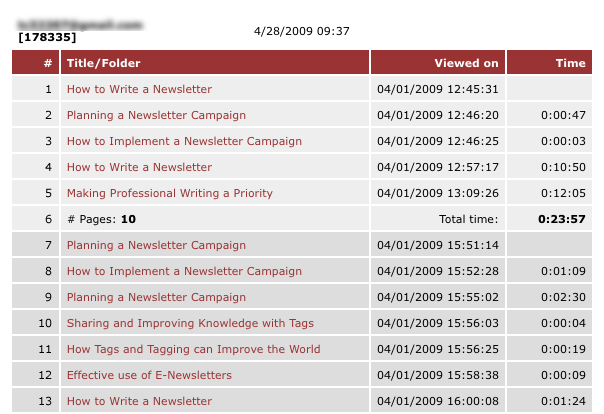
In the screenshot below, you can see some of the tracking data logged by a reader of our last newsletter (I’ve blurred out her email address, but left the numeric ID our system assigns visible). You can see that this person landed on the first page, “How to Write a Newsletter,” and quickly clicked to the third and fourth pages. After spending less than one minute among them, though, she clicked back to the first page and spent over ten minutes reading it, then even more time on the second page, which was really the meat of the newsletter. I can also see that she clicked the link I provided to an older newsletter, “Tags to the World,” on the fourth page. Seeing this level of detail helps me to know a few things: (1) the side navigation menu of the newsletter and the titles of the lower pages were compelling to this reader, which is a good thing, and kept her from bouncing from the page. (2) Having been enticed by the concepts in those lower pages after skimming through them, this reader was willing to spend a much longer amount of time on the second page, where I really laid out my main argument. Finally, (3) I’m not showing this in the screenshot, but this reader went on to view numerous other pages on the site, including previous articles about designing for the web and planning for a web development project. This reader may turn out to be a well informed client-to-be!
But because many readers either check the website itself to see if new content has been added or subscribe to our newsletter using RSS, the tracker numbers are not the only data that we should evaluate in order to measure how well our newsletters, either individually or as a program, are doing. We have much more information available that will help to get the big picture…
Focus on Four Key Metrics
In the graph below, I’m showing four key metrics we focus on and compare when measuring the performance of our newsletter on a month-to-month basis: the number of new subscribers (shown in blue), the number of subscribers that activate our tracker (shown in orange), the number of people who unsubscribe (shown in gray), and the total subscriber count (shown in green).
(If you’d like to see the graph at full size, click it to open a larger version in a new window or tab.)
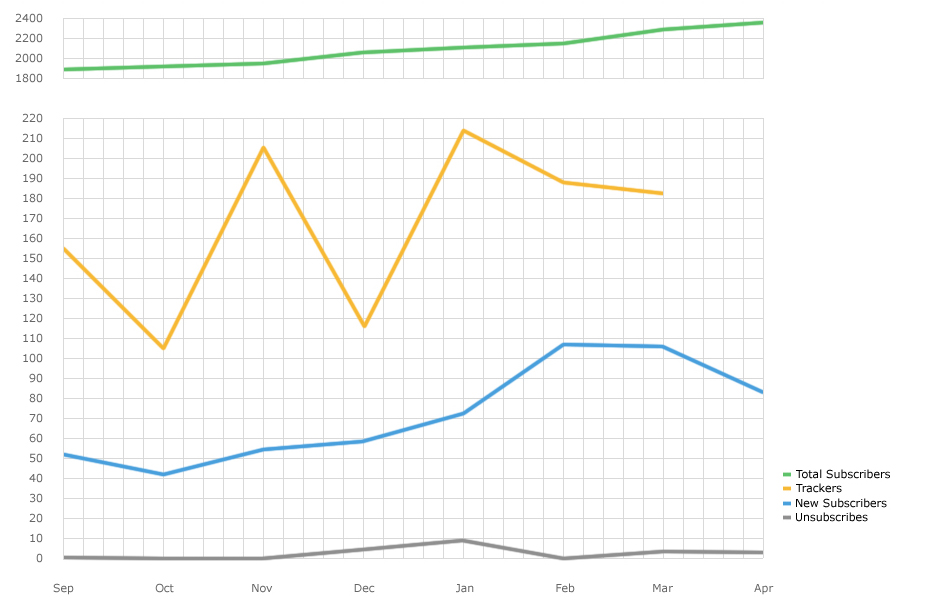
In general, our subscriber base is growing at a pretty healthy rate. In the last six months, we’ve added 450 subscribers, which is an average of 75 per month, or 2.5 per day! We can attribute at least part of this success to the newsletter sign-up CTA that is just about everywhere on our site, but the spike we tend to see of new subscribers on the day we publish a newsletter suggests to me that our emails are often forwarded to people who are not yet subscribers, but end up signing up after reading the email. So in addition to remaining a great alert tool, the emails are also allowing our subscribers to promote us simply by forwarding our messages to others.
As you can see from the graph above, we lose very few readers. We did notice a spike of unsubscribes in January (10), which made me wonder if that was either the result of December’s newsletter being generally uninteresting (impossible, it had Tony Stark in it), or maybe just a matter of some people finally unsubscribing who had been meaning to for a while; the new year will bring about that kind of behavior. In any case, losing ten subscribers only seems like a lot when we’re used to that number being closer to zero for most months. That said, I do think that reader retention is a challenge. How do we do this? I think it really comes down to making sure that your content is consistently worthwhile.
Measure the SEO
So far, I’ve described how to measure the success of your newsletter campaign based on how the email delivery portion generates traffic to your website. However, that’s only the initial piece of your newsletter content’s value. The bigger, and longer-lived, portion comes from how this content benefits your site in terms of search engine optimization.
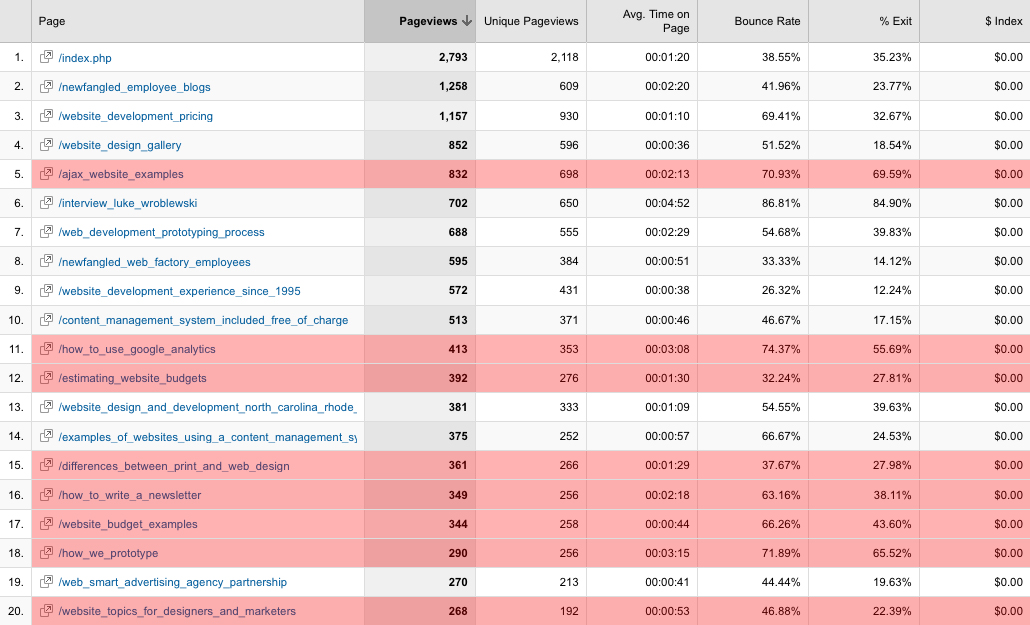
In the screenshot below, I’m showing a Google Analytics report of the top 20 pages on our website and have highlighted the pages among the top 20 that are from our newsletters. 7 out of the top 20 are individual newsletter pages and 1 of them is our newsletter landing page. That means that our newsletter content represents 40% of our top website content. Not bad. Another thing to notice is that 4 of those pages have a bounce rate below 40%, which is also encouraging. (I don’t mind at all that almost 70% of the readers that land on our newsletter about ajax website development leave after reading it- most of them are probably developers themselves, not people looking to hire web developers.) If you’re not familiar with Google Analytics, check out our newsletter on How to Use Google Analytics.
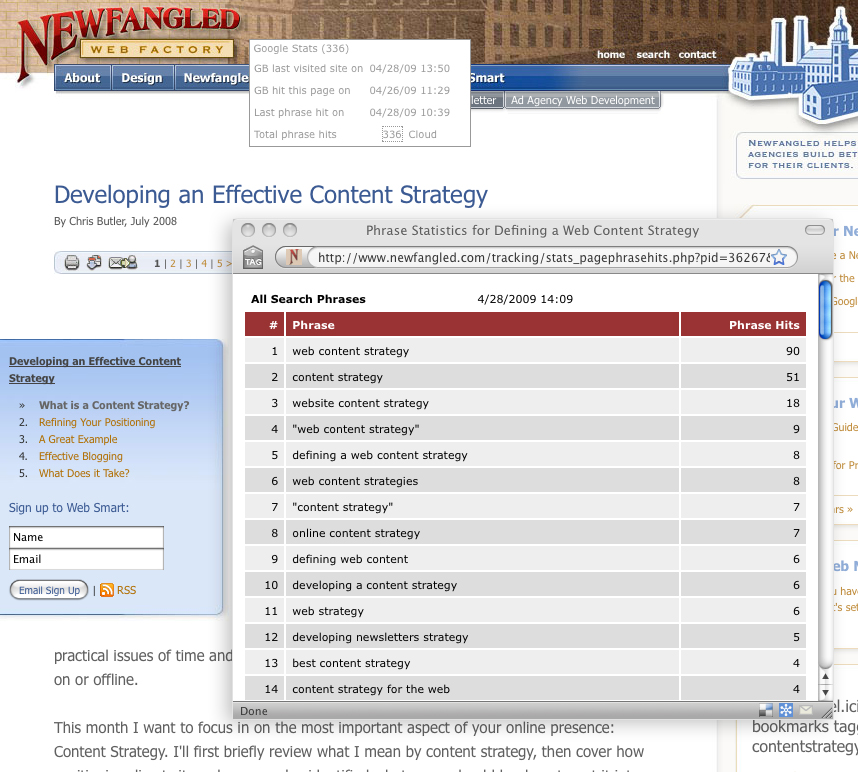
Another measurement step that I make sure to take is to look at the data from our own Google Optimization tools, which includes a tracking system that records every visit from organic Google search engine results pages (SERPs). We record the initial visit, including all page views and the originating search phrase. With this data, we are able to effectively monitor which pages are hit the most from Google, which phrases perform best, and – most importantly – which pages and phrases “stick.” Additionally, we can take this data and place it contextually on every page on our website. In this case, I can go to our content strategy newsletter’s first page and open up the “Google Stats” box that appears if I am logged in to our content management system (see the screenshot below). Right in that small box, I can see the last time that Google indexed the page, as well as the last time a user came to this page as a result of clicking our link among results of a Google search. Incidentally, I can see that the last phrase hit was today at 10:39 in the morning. If I click the total phrase hits number (336), I can browse through a list of phrases, ordered by frequency, that brought visitors to this page from Google. I’m happy to see that the phrases I’d expect to be listed are there- “web content strategy,” “content strategy,” etc.
Optimizing your newsletter content for search engines can be a process of trial and error, but it’s made much easier if your site is being indexed frequently. The more often you add content to your site, the more often Google will deploy its bots to crawl your site. If this is happening on a daily basis, you should be able to start seeing how your content is performing in terms of organic search very quickly. If you’re not happy with the results of your own tests, you can change the meta title and tweak your content and see how those changes affect your placement fairly soon after. I can’t overemphasize the importance of SEO measurement of your newsletter content enough. Remember, your newsletters have a much longer and more valuable lifespan as indexable website content and potential landing pages than they do as email. Emails get deleted.
This newsletter begins what will be a series of upcoming newsletters on different inbound marketing strategies. Newsletters are somewhat of a hybrid of outbound and inbound marketing, but as I’ve tried to stress, the inbound aspect is much more valuable overall. Among the upcoming newsletters, we will cover how to use social media, webinars, and optimizing your website with effective calls to action.
Related Posts
-
Here I am going to indulge myself, and with language fit for Tarzan, Frankenstein or…
-


Mark O'Brien and Chris Butler on the future of web development...
-
Once you have a more complex content strategy, you will probably begin to involve multiple…