 I use stock photography for a good portion of our client sites, selecting them from a handful of stock agencies in order to keep my searching simple and the design budget from ballooning.
I love that there are millions of professional-quality, high-resolution stock images available for download; priced so I can purchase multiple images for a single client. But it wasn’t always this way.
The first design firm I worked for back in the early nineties had a bookcase full of stock photo catalogs. These thick, heavy catalogs were updated every few months and contained only a couple thousand images, categorized by general terms such as “business,” “sports,” or “family.” There was no such thing as a royalty-free images; each image was licensed for a single use and a limited period of time. The costs could run into the thousands of dollars for a single image. Once you selected a stock photo, you called or emailed the stock company and requested the image. The image would arrive via FedEx either as a 35mm slide or 4×5 film. There was a seal affixed to the plastic sleeve encasing the film; if you broke the seal you were agreeing to the terms of the license. You would scan the film in-house for low-res comping purposes and eventually send the film out, (along with the job files) to a pre-production house to be scanned professionally and placed inside the project file. The film had to be returned to the stock company once the project was complete. If you lost the film, the stock company would take your first born child.
Early attempts at providing images online were clumsy. The industry went from phonebook-sized catalogs to expensive CDs containing just a few dozen images, to online stock agencies offering selections basically mimicking their physical catalogs with no means of downloading high-res images (few agencies or design firms had anything faster than a 56K modem).
In the 2000s, online stock photography came into its own. Stock companies like Getty and Jupiter Images offered hundreds of thousands of images to choose from (including royalty-free) with intelligent search capability (images tagged by keyword, color, image composition) and the ability to download non-watermarked comps.
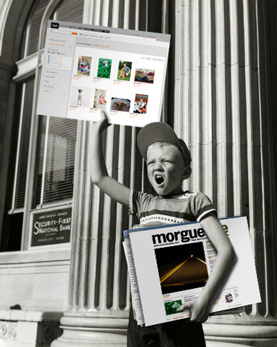
But the real democratization of stock photography began with micro stock sites like iStockphoto* that open their collections to amateur and semiprofessional photographers and sell royalty-free images as cheaply as a few dollars (as opposed to hundreds). Free stock sites like morgueFile and stock.xchng* have leveled the playing field even further. Even large stock companies like Veer and Getty Images have entered the micro stock market. Veer offers inexpensive images from their Marketplace collection and Getty sells photos selected from Flickr, the photo sharing site, starting at $5 each.
Just as blogging brought publishing to the masses, inexpensive, high-quality stock photography is quickly becoming the standard as a valuable resource to the design community.
* Getty Images owns iStockPhoto and recently acquired stock.xchng.